

Sam Neave Interview Part I: Access, editorial control and earning players' trust
The director of the One Team In Glasgow documentary speaks exclusively to The Thistle in a two-part interview
It was the 97th minute. The game was one apiece. Partick Thistle were throwing the kitchen sink at Falkirk, desperately searching for a foothold to save their season, when they won a free-kick just outside the right-hand corner of the Falkirk box.
Kyle Turner stepped up, swinging in a looping cross towards the penalty spot where it met the head of Dan O’Reilly. The centre-half steered it towards goal where Terry Ablade was waiting, with the on-loan Fulham forward steering the most delicate of headers over Bairns keeper Nicky Hogarth.
Firhill exploded. Fans went wild knowing that Ablade’s last-gasp intervention had almost certainly confirmed another end-of-season run in the play-offs. But the celebrations were not confined to Firhill. Over on the other side of the planet, there was a certain director who was furiously checking his phone for updates when he really ought to have been paying attention to the documentary conference he was attending. And he celebrated that dramatic win every bit as much as the red-and-yellow army did.
“At that moment, I was in Baltimore, I was doing this documentary conference, and I was just checking the score,” Sam Neave, director of the four-part One Team In Glasgow documentary that is now available on STV Player, tells The Thistle.
“I saw that last-minute, 97th-minute winner for 2-1. I got a call from David [Maccormack, producer], he’s like, ‘It’s f***ing happening, something’s f***ing happening!’.”
Sam could be forgiven for feeling a wave of relief washing over him. It wasn’t just the Jags’ season that was hanging in the balance that evening, after all. The three-time Emmy-nominated filmmaker and his crew had been following the team throughout the 2024/25 campaign, capturing all the highs and lows of the reality of life behind the scenes at Firhill.
Matters on the park were of course out of his control, but that didn’t mean Thistle’s fortunes were irrelevant. Quite the opposite, in fact.
“When we started, we obviously didn’t know what was going to happen,” Sam explains. “I said to Donald [McClymont, the club investor who funded the documentary], ‘We can film, but we can’t control the football and we don’t know what’s going to happen’. So can we make storylines outside of the football? And there were enough storylines and characters that we could follow.
“But at that moment when it looked like they might not get into the play-offs, I think there was a real feeling that this might not be worth it. Is there anything? What are we going to do? How am I going to end this thing, if they literally don’t make it? If they’ve sacked Kris Doolan then these guys have done well, but maybe not well enough?
“And then it ended up being more than that. I was here for the next game, I was here for Livi and the Ayr United play-off and all that. So we saw amazing things from that point in terms of football.
“And then in terms of not football, to me it was the sort of gallows humour and the people around it. All the characters are the reason I was like, ‘Maybe there’s a show here’. Because the fanbase is just unique in many ways.
“We’re following a group that are underdogs of course, but there’s lots of underdogs. But they also play in the shadow of these two monster teams in this city, so they have something else about them. They’re also driven in a way. Other clubs of this size have fanbases, but not like this.
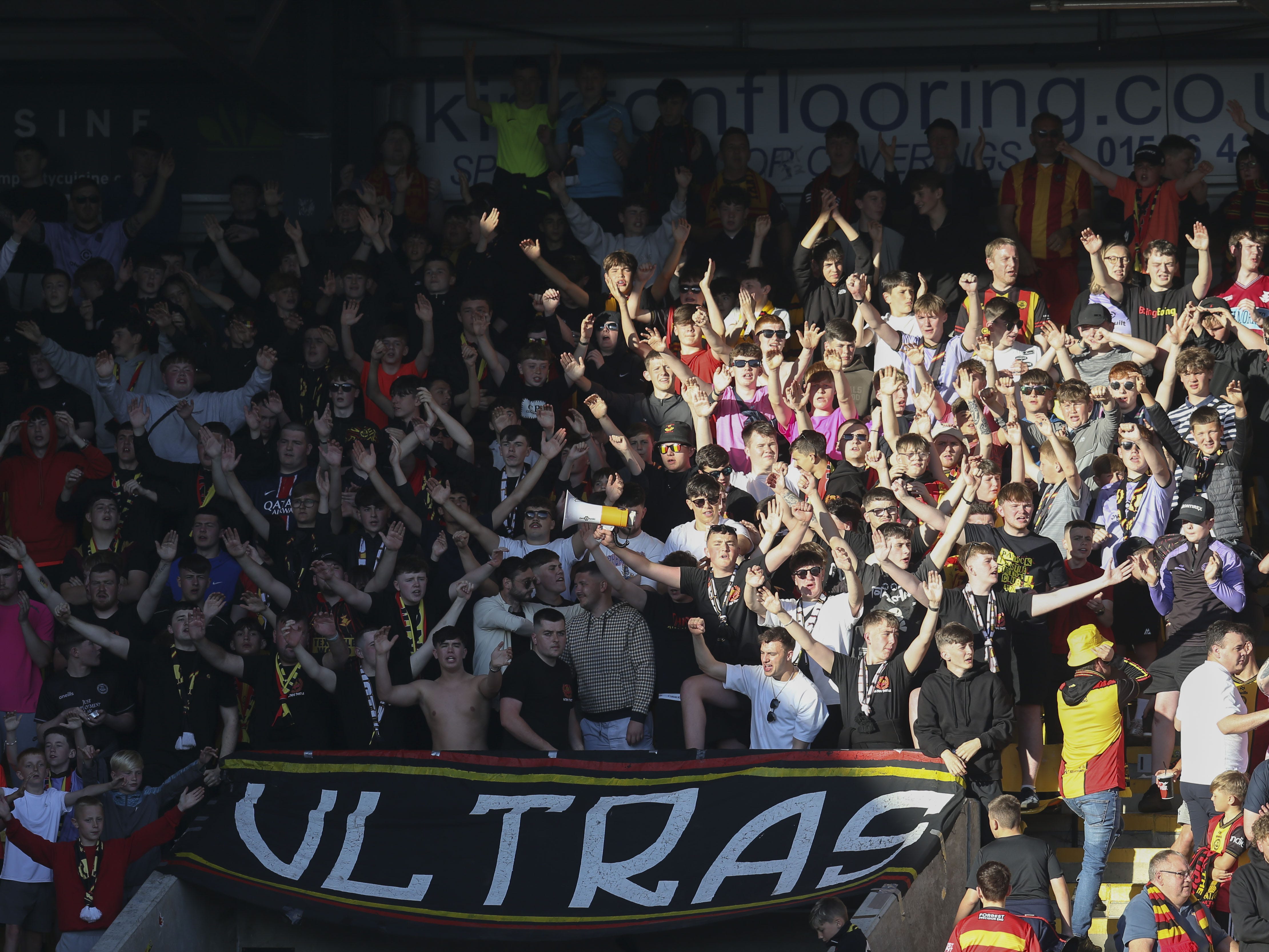
“That Livi game where they’re basically down 4-0 [in the play-offs] and they’re still out-singing the Livi fans - that says something about them as a fanbase. I think that was kind of the thing that initially drew me to want to make a story about them. It’s really about them, it’s not about the football. Ian [Mackinnon, supporter and documentary contributor] puts it very well in the show. He says, ‘It’s a great day out, ruined by 90 minutes of terrible football’.”
Sam continued: “It had to be about characters and storylines. One of the fans says this at the beginning of the show: ‘We don’t win, I’ve been here for 50 years and we’ve not won anything’. So, why are you here? That question of why are you here, what brings you to this place, what keeps you here - that’s the underlying theme.
“And I think that’s true not just for this club, obviously. That’s true for most clubs that aren’t the Arsenals and the Citys or Celtic or Rangers. I think most fanbases have to ask themselves that question at some point: Why are you here? And that’s an interesting one to me.
“That, hopefully, is what we’re pointing at in the show. To me, that was what was interesting as an outsider. I didn’t come in here as a Thistle fan, but I learned by the end of this why they are Thistle fans. And that’s what I hope that comes across in the show.”
Read more
The Sultan of Ping: Forbes still making magic with wand of a left foot
Covid, demotion and winning League 1: Cardle on his eventful stint at Firhill
No areas were off-limits for Sam and his crew during their year of filming the trials and tribulations of the Jags. That level of unfettered access – to the dressing room, to board meetings, to the wheeling and dealing of transfer deadline day – provides supporters with a glimpse of how the sausage really gets made at Firhill.
That level of trust goes two ways, though. The club were happy to open their doors and allow the cameras in, but it was with the understanding that Sam would give an honest account of what transpired. Understandably, he was keen to ensure he retained full editorial control.
“We were obviously allowed into all the matches,” Sam explains. “But we were also allowed into dressing rooms, we were allowed into all the training sessions, video training, the manager. When it was Kris and Paul [McDonald, Doolan’s assistant], they talked to us at length about what they were thinking in multiple interviews.
“The players - we would never force anyone to do it - but the players who were up for chatting with us, we would talk to them, and some players understood the value of it more than others. Some didn’t want to really be involved in it, and that was fine, but those that did, we could sort of follow storylines. And of course, it works well when you follow a storyline and then it shows up on the pitch.
“We did some stuff with Myles [Roberts] and it paid off because he was the best goalkeeper in the league at that time, and then he went away. So it had a narrative edge to it as well as a human edge of meeting this guy. So there were ways that that access was great.
“We were allowed into board meetings, which were not always that fun. But there are moments that you pick – the transfer window is a really exciting time. That’s a fun thing where you get to see a little bit behind the scenes. We’ve got Richard Beastall, who was the chairman at the time, in with Kris and Paul and Graham McRoberts [acting general manager], and they’re all just going, ‘Well, what are we going to do?’ and you can see it. And meanwhile Donald and others are on the phone going, ‘We’ve got to cut the budget, we don’t have the money’.
“The other thing is it’s one thing to give you access, it’s another thing to control how you use that stuff - and they were very, very good about staying out of it. At one point, there was a question, ‘Is this going to be just a branding video?’ if an investor in the club is behind funding the documentary. But they never once had any right of editorial, and Donald only ever watched stuff that was finished.
“So we were given not only the access to film what we wanted, but also to tell the story that we wanted. And so it was really me and Adam, the editor, that were following the storylines that we thought were interesting.
“And ultimately, it’s not controversial. It’s the same ones that you’d think. We get into fan ownership, we get into Kingsley’s origins, we get into Jags for Good, and we get into the periphery, the volunteers, stuff like that. We get into all that, but really it’s about what’s happening on the pitch and how it’s received off the pitch. That generally becomes the story.”
With the cameras rolling in the dressing room for the entirety of the 24/25 campaign, they were bound to pick up one or two unsavoury moments that the club would probably prefer not to be in the public eye. The documentary is supposed to capture the good, the bad and the ugly, after all.
One such incident was used in adverts for the four-part series, where Brian Graham and David Mitchell square up to each other at half-time during a match. From a storyteller’s perspective, these are the moments that Sam says demonstrate just how much is on the line.
“Brian, at times, comes across really, really well in the doc,” he noted. “And at times, he comes across as a bit of a character in the dressing room - going at people, fighting with people. We ask him about it. We say, ‘What’s up with that? People say you’re angry’. And he goes, ‘I’m angry, but it’s because I want to win, and there’s a difference. I’m not just angry for the sake of anger’. He justifies it, he tells his part of the story.
“No one ever said, ‘You can’t use this’. And s*** does happen in the dressing room. One of the things that me and Adam found as we were cutting it was how interesting it is. There are very few professions in which you could have an argument, almost a fistfight basically. In that moment, it’s at half-time, and then they go out and they play. And then after the game, the next day, they’re back to normal. They understand they’re here for a reason.
“And so that intensity of the relationships, that intensity of what they’re trying to do, where they have to be in order to make it happen, comes across. It’s not like our jobs where if I were to go around screaming, people wouldn’t work with me. There are directors, I guess, who are like that! But it doesn’t work. There’s just a different level of pressure that they’re going through, and we do get to see that.”
Earning the players’ trust early on was key. Sam first met the squad in the aftermath of a 2-1 win over Airdrieonians in May 2024 – a game perhaps best remembered for Wasiri Williams leading chants in the John Lambie Stand armed with a megaphone – to let them know about the project. He began his introduction by saying, “There’s one thing I’ve already learned – everybody hates f***ing Airdrie!”. It was received with hearty cheer inside the dressing room.
Read more
Wilson excited for Thistle fans to get peek behind curtain in new documentary
TJF urge Thistle fans to get involved with board elections on horizon
“You establish early on that you’re not trying to upset the balance, you’re not getting involved, you’re not the story,” Sam explains. “So when we had dressing-room cameras, we weren’t in there the whole time. We mounted a camera, and most of the time they forgot about it. Which is what we want.
“We would go in occasionally with a camera just for five minutes post-match. I would make it minimal, so it would just be Rory [Dunning, director of photography]. So it would just be one guy who goes in that they know, that the team is now familiar with.
“I think the way that you do this stuff matters, and your ability to stay as a neutral observer, genuinely as a camera, is important. If you’re trying to take advantage of a moment or manipulate a moment, I’m not into that at all. So I think that helped us, once they understood that we were going to let the story dictate what it is.
“The thing about the players is some of them are just more comfortable with the idea of being interviewed or being on camera than others. And it wasn’t something we would even try, really. But you could kind of tell, people who would come up to you early on.
“Banzo [Stuart Bannigan] came up to me and just started talking with the camera. And I think he understood because he was an elder statesman of the club. And Brian too - the two of them understood that if they show that this isn’t scary, everyone else will be like, ‘Okay, sure’. And then there were people who were going through stuff in their lives, who I think just didn’t want that element of it.
“Harry [Milne], we were talking about doing something, and I think he knew he was going to leave, so he kept pushing us off, pushing us off, and then he left. And I knew then that, ‘Okay, that’s the reason he’s done that’. Because he did talk to us at the beginning of the season, sat down, and he’s in it. But it was clear that he was biding his time a little bit in terms of getting really deep into it.
“And then there’s some people… sometimes the story has to go somewhere. We did a lot of stuff with Stevie Lawless on his comeback. But the comeback never really materialised. If there had been this moment where he’d come off the bench, and scored and won the game, then the story makes sense. But because it didn’t… I mean, he’s in the show, but we shot a lot more than you see in the show.
“Similarly, Ben Stanway. We followed him a bunch, and we knew that he was going to be a story, but he kept getting injured and so we couldn’t. It was stop-start. I think initially, maybe he didn’t quite know what the advantage of being in it was. And by the end, he did. I think he came around in a way, but he’s not really a presence in the show because it didn’t materialise in that way. Something’s got to happen, they [the characters and the plot] have got to speak to each other.
“We had an amazing sequence that I cut from the film about Wasiri early on because he was such a great character. I was sorry to lose him. But he was just great, great value. That first game, he was in the stands with the megaphone. So we have amazing footage, and then he comes in and he’s got this spider.
“He’s caught this spider and he’s just doing pranks and shenanigans, which is everything you want. And then [Kanayo] Megwa comes in and he has to leave, basically. He’s just like, ‘I’m not going to get involved’, and he leaves. There was a ten-minute sequence that we cut. It’s a great little thing, but there was nowhere in it in the show for it.
“I think, also, now we’re living in an era of constant filming. People are filming themselves constantly. The idea 20 years ago of ‘We’ve got a camera crew in here’ was a much bigger deal than it is today. Everyone is posting, everyone is doing their own version of this to some degree.
“So I think I go back to the thing of what’s your intent? Can you be trusted? And that was my whole thing at the beginning. It was really important. I need to make sure Brian and people at the club understand that we are trustworthy.
“It’s the first thing I said to the players after telling them that everybody hates f***ing Airdrie, that I’m also just here because I want to tell the story right. I want to get it right. The only way I can get it right is with your help. I could make a version on my own but it’s not going to be any good. So, you have to kind of see what you can get from people.”
Sam continued: “Banzo and Lee Ashcroft, they were sort of friendly with each other. They would go out, they’d walk their dogs together, they’d play pool together, they’d go to the driving range together, they’d go and have a coffee. So we would put them in situations together where we would just chat with them.
“Initially, for instance, they talk about contracts, Scottish football at their level. They’re like, ‘Look, it’s great, we get to play football for a living. But at the same time, we never know where we’re going to be in two years’. These days, no one’s giving you a five-year contract. They’re always giving you a short-term deal. So it’s very precarious, especially as you get older in your career, and both of them are not young anymore. So they would give insights like that.
“I found that if we talked to them about stuff like that, where they could actually give us information, it was very helpful. And then they had a great insight when Kris and Paul were let go. They had a great take on it, just being like, ‘It’s a shocker’. Banzo was like, ‘I was his team-mate, we go back a long way, and it’s on us’. And then they were also like, ‘But you know what? Training and stuff, it’s not what it used to be. These days, you can’t... There’s like a softness’.
“And these are two of the tough guys. They talk about, back in the old days, if you were a kid and you were brought up to the first team and you didn’t quite perform, they would just say, ‘Get them f***ing back’. And he’s like, you can’t do that now. Banzo goes, ‘What would they call that? Bullying’. He says it with a grin on his face. So to me, that’s the kind of thing that I found fascinating from them, rather than tactics or training.”
Part II of The Thistle’s exclusive interview with Sam Neave will be published tomorrow. One Team In Glasgow is available to watch on the STV Player.